
There is one specific dessert that signals the official start of summer in my kitchen. It’s not fancy, it doesn’t require complex French pastry techniques, and you definitely don’t need a degree from culinary school to pull it off. It is the American Flag Sheet Cake.
I remember the very first time I tried to make one. I was maybe twelve years old, helping my aunt prepare for a massive neighborhood block party. We were ambitious. We decided to dye the entire cake batter red, white, and blue in distinct layers.
Spoiler alert: It was a disaster. The colors bled, the layers didn’t bake evenly, and when we sliced it, it looked less like Old Glory and more like a tie-dye experiment gone wrong. We ended up covering the whole messy thing in a half-inch of vanilla frosting and hoping for the best.
But that failure taught me something crucial about summer baking: Simplicity wins.
This American Flag Sheet Cake recipe I’m sharing today is the result of years of refinement. I traded complex, internal food coloring for a perfect, plush white velvet cake that acts as the perfect canvas. I developed a stabilized cream cheese frosting that actually holds its shape, and I use the fresh, vibrant colors of summer berries to do all the heavy visual lifting.
Every time I pull this cake out of the fridge on the 4th of July or Memorial Day, people gasp. It’s a showstopper. But when they ask me for the recipe, I almost feel guilty telling them how simple it actually is. This is the dessert that will make you the hero of the barbecue, and I promise you, it is genuinely foolproof. Let’s make it.
Why You’ll Love This Recipe
- Completely Foolproof: Forget about bleeding food coloring or uneven layers. This is a simple white sheet cake decorated externally; it looks complex but is incredibly forgiving.
- Feeds a Crowd: Baked in a standard 9×13 pan, this cake naturally serves 12-15 people (or more, if you cut smaller pieces), making it ideal for large gatherings.
- Make-Ahead Friendly: You can bake the cake a day early, and the stabilized cream cheese frosting holds up beautifully in the fridge.
- Naturally Stunning: We rely entirely on fresh, seasonal fruit for the vibrant red and blue colors—no artificial dyes are needed for decoration.
- The Frosting is Magic: This stabilized cream cheese frosting is tangy, sweet, and firm enough to slice perfectly, unlike many drooping frostings.
Ingredients List
To make this iconic American Flag Sheet Cake, you will need ingredients for the plush white cake, the tangy stabilized frosting, and the fresh fruit topping.
For the Plush White Sheet Cake:
- 2 ½ cups (300g) Cake Flour: (Pro tip: Don’t swap this for all-purpose flour if you can avoid it. Cake flour gives that ultra-fine, velvety crumb that defines a great white cake.)
- 1 ½ cups (300g) Granulated Sugar
- 1 tablespoon Baking Powder
- ½ teaspoon Salt
- ¾ cup (170g or 1 ½ sticks) Unsalted Butter, softened to room temperature
- 1 cup (240ml) Buttermilk, room temperature
- 1 teaspoon Vanilla Extract
- ½ teaspoon Almond Extract: (This is my “secret” ingredient—it adds a nostalgic bakery flavor that takes the white cake to the next level.)
- 4 Large Egg Whites, room temperature
For the Stabilized Cream Cheese Frosting:
- 1 (8 oz or 226g) block Full-Fat Cream Cheese, softened to room temperature
- ½ cup (113g or 1 stick) Unsalted Butter, softened to room temperature
- 3 cups (360g) Powdered Sugar (Confectioners’ Sugar), sifted
- 1 teaspoon Vanilla Extract
- 2 tablespoons Heavy Cream (optional, for thinning if needed)
For the Fruit Decoration:
- 1 pint (approx. 2 cups) Fresh Blueberries
- 1 pint (approx. 2 cups) Fresh Raspberries: (You can also use sliced strawberries if you prefer, but raspberries offer that perfect deep red “stripe” color.)

Step-by-Step Instructions
This recipe uses the standard “reverse creaming” method for the cake, which guarantees a tender crumb and prevents overmixing. It’s my favorite way to make a white cake.
Step 1: Prep Your Materials and Oven
First, preheat your oven to 350°F (175°C). We need it nice and hot when the batter is ready. Take your 9×13 inch metal baking pan—the metal helps achieve that beautiful golden edge—and grease it generously with butter or non-stick cooking spray. For absolute security against sticking, I always line the bottom with parchment paper, leaving a little overhang (a “sling”) on the long sides so I can easily lift the entire cake out later for perfect slicing.
Step 2: Mix the Dry Ingredients
In the bowl of your stand mixer fitted with the paddle attachment (or a large bowl if using a hand mixer), combine the cake flour, granulated sugar, baking powder, and salt. Turn the mixer on low for 30 seconds just to whisk everything together and break up any large flour clumps.
Step 3: Add the Butter and Liquids
This is the reverse creaming part. Add the softened butter, buttermilk, vanilla extract, and almond extract directly to the dry ingredients. Mix on low speed until the mixture looks like wet sand—everything should just be moistened, with no large clumps of butter remaining (about 1–2 minutes). Be careful not to overmix here.
Step 4: Whip the Egg Whites (The Secret to Lightness)
In a separate clean bowl (crucial: it must be grease-free!), whip the 4 egg whites on high speed with a whisk attachment until they reach stiff peaks. This takes about 3-4 minutes. This adds critical aeration to the cake.

- Material – Paper flag, wood toothpick.
- Size – Flag size 1.4in×1in. Stick size 2.5 inch.
- Package – 100 toothpick flags.
Step 5: Fold the Batter and Bake
Gently fold one-third of the whipped egg whites into the main flour-butter mixture using a rubber spatula; this lightens the base batter (which should look thick, like the image above). Then, add the remaining egg whites and fold gently until just combined. Do not mix forcefully or you will deflate all that beautiful air.
Pour the batter into your prepared 9×13 pan and bake for 28–32 minutes.
Step 6: Cool the Cake (Patience is Key!)
You will know the cake is done when a toothpick inserted into the center comes out clean or with just a few moist crumbs. The top will be lightly golden brown and springy (as seen in the image).
Now, this is the most important step: Let the cake cool completely in the pan. If you frost a warm cake, the frosting will turn into a puddle, and your entire design will collapse. I usually let it cool for at least 2 hours on a wire rack.

Step 7: Make the Stabilized Frosting
While the cake cools, whip up the frosting. In a clean stand mixer bowl, beat the softened cream cheese and softened butter together on medium-high speed until perfectly smooth, creamy, and pale (about 3 minutes).
Add the sifted powdered sugar, one cup at a time, mixing on low speed to avoid a sugar cloud, until incorporated. Increase speed to high and beat for 3 more minutes until fluffy. Add the vanilla and mix to combine. (The result should be thick and hold its shape, like in the next image).
Step 8: Apply the Frosting
Once the cake is 100% cool, you can frost. Take a large dollop of frosting and use an offset spatula to spread it smoothly over the surface. The spatula glides through the thick, creamy frosting (as captured in the image). Create as smooth a surface as possible; this is your canvas.

Step 9: The Blue “Stars” Section
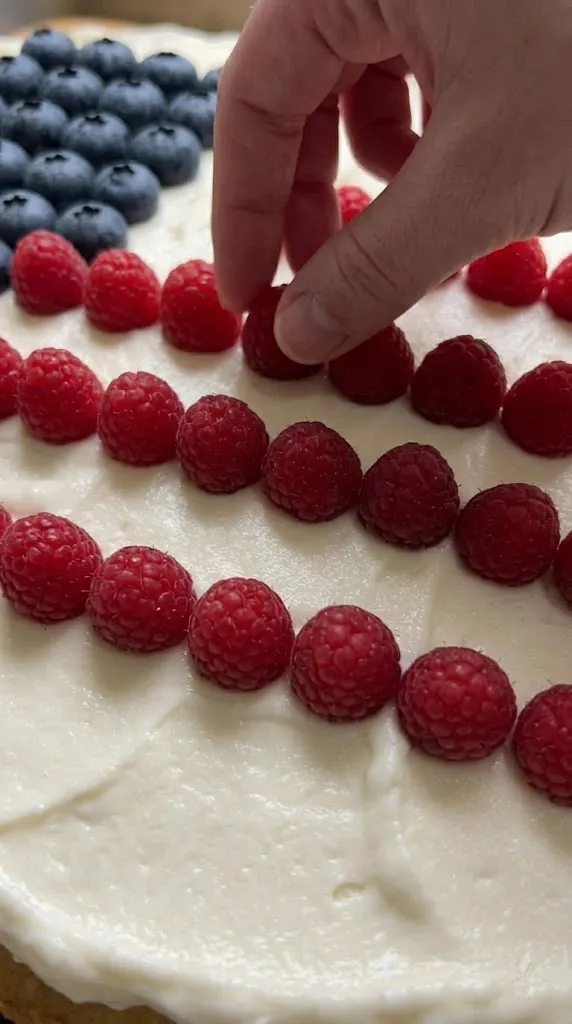
Now the fun part: decoration! Start in the top-left corner. Take your fresh, dry blueberries and carefully place them in a dense, neat rectangular block to represent the union (the “stars” section of the flag). As shown in the image above, the key is to place them close together in straight rows to form a solid square of blue.

Step 10: The Red “Stripes” Section
Next, we create the stripes. Start immediately to the right of your blueberry block. Create a tight horizontal line using raspberries. (I always start at the top and work down.) Lay the first line of raspberries, creating the first red stripe, as seen above.
Leave about an inch of white frosting exposed, then lay the next line of raspberries to create the second red stripe. Continue this pattern all the way down the cake, alternating raspberry stripes with white frosting stripes. (For a traditional 9×13, you will usually end up with 7 or 8 red stripes). Refrigerate for at least 1 hour before slicing to set the design.
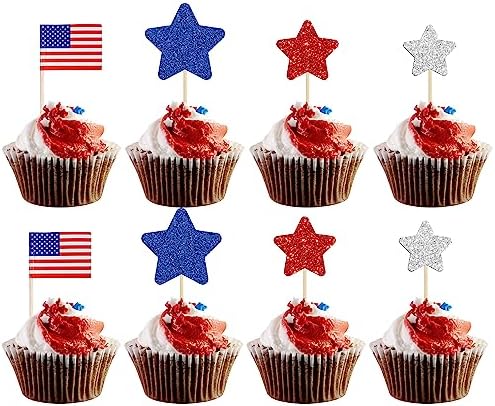
- Package included: 100Pcs Flag Picks. Comes with assembled, so you can insert into your cake directly, which make your ca…
- Premium Material: These Flag Picks are made of high quality card stock and food-grade toothpick, very safe to put them o…
- American Flag Picks are so cute and good for patriotism activities, sports events, home, office, bar party cupcake decor…
Pro Tips & Tricks
- Cool the Cake (Again, seriously!): I cannot stress this enough. If you frost a warm cake, the fruit will slide, and the frosting will melt. Make the cake the night before if you need to!
- Measure Your Fruit: Don’t just dump the berries on. For a neat flag pattern, select berries of a similar size. Use a small ruler or a clean chopstick to help you define straight lines for the raspberries if you’re worried about eye-balling it.
- Dry Your Berries Completely: After washing your fruit, make sure every berry is completely dry before placing it on the frosting. Moisture on the berries can make the red color bleed into the white frosting, ruining the sharp stripes.
- The Slicing Strategy: To get perfect, clean squares, use a large, sharp knife. Wipe the knife clean with a hot, damp cloth after every single slice. This prevents smearing the white frosting and keeps the fruit lines sharp.
Variations & Substitutions
- Go Strawberries: If you prefer strawberries, wash and hull them, then slice them vertically. Lay the strawberry slices in overlapping rows to create your red stripes.
- Dynamic Piping: For a texturally interesting cake, instead of leaving the white stripes flat, you can place your fruit stripes, then use a star tip to pipe small rosettes of frosting in the empty white channels. This adds a beautiful dimension (though it is more time-consuming).
- Gluten-Free Version: To make this gluten-free, simply swap the cake flour for a high-quality 1-to-1 gluten-free baking flour blend. Make sure it contains xanthan gum. The texture won’t be quite as velvety as the cake flour version, but the cream cheese frosting hides it well.

Serving Suggestions
This cake is the undisputed star of any outdoor barbecue, potluck, or 4th of July celebration. Since it feeds a large crowd (about 15 large slices), it’s best served straight from the sheet pan on a buffet table.
While the cake is spectacular on its own, it pairs beautifully with a simple scoop of high-quality vanilla bean ice cream or a dollop of fresh, lightly sweetened whipped cream. (Just make sure you serve it with a sturdy spatula; the first corner slice is always the trickiest to get out neatly!).
FAQ’s
Can I make this cake ahead of time?
Absolutely. This is the ultimate make-ahead recipe. You can bake the white cake up to two days in advance; just cool it completely and wrap it tightly in plastic wrap (leave it in the pan). You can also make the frosting 24 hours ahead and store it in an airtight container in the fridge (re-whip it briefly before using). For the best appearance, I recommend assembling the final fruit pattern on the day you plan to serve it.
How do I store leftovers?
Because of the cream cheese frosting and fresh fruit, this cake must be stored in the refrigerator. Cover it loosely with plastic wrap (you might want to stick a couple of toothpicks into the cake to tent the plastic so it doesn’t touch your fruit art). It will keep well for 2-3 days, though the juice from the fruit may begin to slightly bleed into the frosting on day three.
Can I use frozen berries?
No, I strongly recommend against using frozen berries for this decoration. Frozen berries are significantly wetter when thawed and will immediately bleed dark red and purple juices into the white frosting, destroying the clean lines of the flag design. For this decoration, only fresh berries will do.
What’s the best way to slice a sheet cake?
The easiest way is to cut the cake while it is still cold from the fridge. Use a sharp, thin-bladed knife. Make vertical cuts down the length, then horizontal cuts to create squares (usually 3 cuts by 4 cuts for 12 large pieces, or 3 cuts by 5 cuts for 15 pieces). Crucially, wipe the blade clean and dip it in hot water between every single cut for the cleanest presentation.
Can I bake this in a 9×13 glass dish?
You can, but metal pans are generally better for cakes as they conduct heat more evenly and help create a better crust. If you use glass, keep an eye on the baking time; it may take 5–8 minutes longer to bake through.
Related Recipes:
- Top 8 Father’s Day Cake Recipes – Easy Dessert Ideas
- Old-Fashioned Snowball Cake – Classic Coconut Dessert
- Hawaiian Pineapple Cake: Moist Tropical Dessert
- Strawberry Buttermilk Pound Cake
- Chocolate Brownie Cake Recipe
Closing Thoughts
There is a simple joy in bringing this American Flag Sheet Cake to the table. When the cake is cut and you see the first slice, with the perfect squares of blue and lines of red, you realize how much happiness such a simple concept can bring. This recipe isn’t about striving for perfection or professional culinary precision; it’s about sharing a vibrant, festive, and delicious dessert with the people you love.
I hope you give this recipe a try at your next summer gathering. Don’t worry if your raspberry stripes aren’t perfectly straight—no one will care! Once they taste that velvety white cake and the tangy cream cheese frosting, they’ll just be asking for seconds.
Happy baking, friends! Let me know in the comments how your flag cake turned out!

